Seeking descendants: translating issei haiku
Translating haiku into English with context and emotion
By Carolyn Nakagawa and Yoriko Gillard
Note from Carolyn: This essay is also published in The Bulletin (January 2026) and Nikkei Voice (February 2026).
Carolyn Nakagawa, a fourth-generation Japanese Canadian poet, playwright, and researcher, and Yoriko Gillard, a Japanese-born poet, artist, researcher, and educator, have spent the past year working together to develop a haiku translation practice based on poetry written by Issei in internment camps. Here, they introduce their research process and some of their translations, and list the authors they have been working with in hopes that their descendants will get in touch.
Carolyn: I’ve long been curious about the collections of Japanese-language poetry written by survivors of internment during their time in the camps. Although I am a rarity in my generation for having had the opportunity and privilege to study the Japanese language, I haven’t felt confident reading poetry in Japanese. I want to break this barrier between myself and these poems. Who is better suited to appreciate haiku written in internment camps than me, a poet who has studied both Japanese Canadian history and Japanese language?
Yoriko: Every time I learn about the history of Japanese Canadian people during 1942-1949, my heart aches and often my emotions take over with tears. Through this project, I resonate with Japanese Canadians’ past and their ways of living resiliently through hardships with Haiku. As a writer and poet, haiku and any Japanese poetry practices are the reflection of my soul.
Carolyn: We have spent most of our creative research collaboration so far working with a broadsheet of poems published in honour of the anniversary of the Lemon Creek Haiku Club: a copy of it is stored in the Kinori Oka collection of the Nikkei National Museum archives. It contains over seventy haiku written by authors in various locations throughout British Columbia, including several internment camps in the Slocan Valley, and some poems from the Okanagan. They all incorporate the prompt of “Tsubame”, or “swallow”, which Yoriko says is a seasonal word that indicates spring.
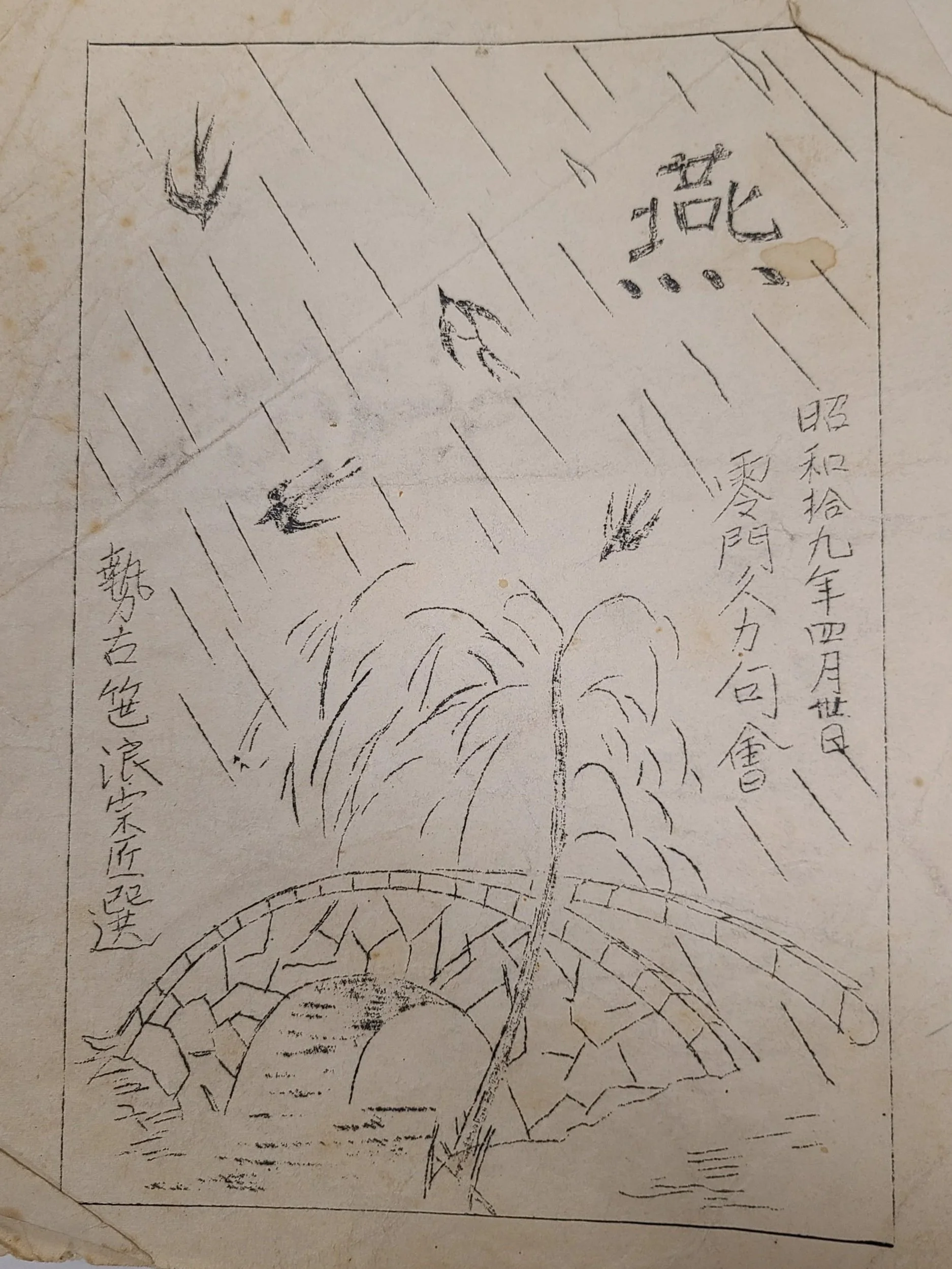
Cover of “Tsubame” broadsheet haiku collection. Kinori Oka collection, Nikkei National Museum & Cultural Centre 2001.28
For each haiku, Yoriko and I discuss to confirm that I understand the literal meaning correctly. Then we discuss what the poem makes her feel, and she asks how I connect with it, until the poem means something emotionally to me. I write my own version in English, in the form of questions for the poet. I ask them about the experiences that led them to write; questions I’ll never be able to ask my grandparents or great-grandparents.
河挟む對山高し飛ぶ燕
パポーフ 森本参木
How close does the river hold you,
surrounded by tall mountains?
How high does the swallow fly,
clearing their peaks?
Yoriko: Throughout this process, I guide Carolyn to critically think about her ways of understanding haiku through her own feelings as well as historical knowledge. However, I have no intention to correct her understanding of the language. My focus is to immerse myself in her way of seeing the haiku. At the same time, I share my vision with her without forcing her to think of my view as the correct one.
My collaboration with Carolyn is not about direct translation, but about the process of understanding through mutual trust that we can share with readers. We wish our soulful interpretation of those courageous Japanese Canadian survivors' art will guide people who feel distant from their ancestors to connect with their great gifts.
暮れ残る湖面掠めてつばくろめ
カスロー 風耒村
Why did you see the swallow
glancing off the surface of the lake?
Was the lingering dusk-tinged light
enough in that reflection?
Carolyn: Most of the poems we worked with from the Lemon Creek haiku club collection are signed with the poet’s surname, pen name, and location. We are planning to publish further translations in the future, and would like to keep family members informed about this process. If you see a name and location in the below list which you think matches a relative of yours, or if you would simply like to be notified when further work from our project is published, please contact me using the contact form on my website, or by emailing cynaka15[at]gmail.com.
We gratefully acknowledge support from the Japanese Canadian Legacies Society (JCLS) Community Fund "Arts" Stream for this project.
静けさの明けを囀る里燕
スローカン 佐藤若鬼
Which hometown greets you
in this swallow’s warbles, in the quiet of dawn?
“Tsubame” haiku author surnames (pen names removed) - listed by location
-
Midori Takaoka
Sasanami Seseki
-
Arai
Kanda
Miyazaki
Sasaki
Suyama
Yoshida
-
Hayashi
Ikeno
Ito
Kohigashi
Komiyama
Kubo
Maruyama
Masuda
Mio
Nakamura
Oka
Tonegawa
Ukizawa
Yamazaki
-
Hattori
Mizuno
Ogura
Uchibori
Yamazaki
-
Hikichi
Horiuchi
Sakae
-
Morimoto
-
Hattori
Hayashi
Hayashiba
Kondo
Mio
Nakasuji
Sugiman
Watanabe
Yabuki
Yamamoto
Yoshikawa
-
Kitamura
Sato
Shikatani